Helen Calvert Maxwell Read (1750-1833)
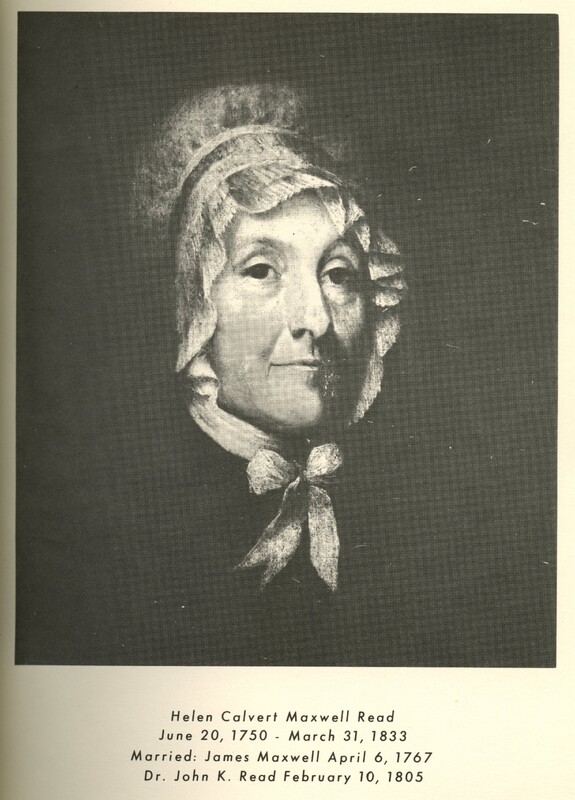
This is a sketch of Helen. Memoirs of Helen Calvert Maxwell Read was published in 1970 by the Norfolk County Historical Society of Chesapeake, Virginia. The original form of the memoir was written in two parts, but the second half that led up to Helen’s death was burned in the Civil War.
The Calvert Family
Helen was born in Norfolk, Virginia on June 20, 1750, to Maximilian and Mary Calvert. She had five siblings: Jonathan, Mary (who is referred to as Polly in the memoirs), Savage, Maximilian, and Margaret.
Helen’s father Maximilian was a sailor, a store owner, a Mayor, a Revolutionist, and a drinker with a bad knee. As a child he was described as one of “...the worst boys in all the town.” He was in opposition to the tax on tea at the time, and banned all of it in the household, but the rest of the family took up drinking it secretly, in a coffee pot instead of a kettle. “The truth is, if he was a good patriot, he was also a kind father, and naturally disposed to wink at our little indulgences when he knew they could do no harm.” Helen wrote fondly of him in the memoirs, and even claimed to be his favorite: “...my father, who thought me a very fine, smart girl (for I was always his favorite)...” He passed away from smallpox around the year 1780.
One funny thing of note was that Mr. Calvert used to host patriots in the house, and one time invited Major General Charles Lee to stay with them. He brought with him, “...four ugly little dogs, which he petted [and] pestered every body with.” The family gave Lee a large bedroom to stay in with two beds, and they were not pleased to find the next morning that Major General Lee had slept in one of them, and all four of his dogs slept in the other.
Helen’s mother Mary was from Bermuda, and was orphaned from an early age when she was brought to the U.S. “She was, indeed, a prudent, notable, and amiable woman, a good Housewife, and the best sewer on cambric I ever knew. She looked well to her household, and the heart of her husband trusted in her. She was, moreover, piously disposed, and remarkably fond of her Bible, which she taught us all to read betimes.” Unfortunately, in her later years, Mary became a recluse, hardly ever leaving her house, and she died in 1804.
Helen recounts her first memory, which was of her brother Cornelius’ death when she was four years old.
One of Helen’s brothers, Maximilian, referred to as Max in the memoirs, had “fits” quite often, due to his “growing too fast.” As he grew older, they became more common and were attributed to his intense study at the College of William and Mary. He took the fall for a group of students at school who were misbehaving, even though he did not know who they were, and the staff reportedly flogged him, “...with so much severity that it affected his health and his mind.” He died from one of the fits.
Growing Up
Helen was extremely educated, and she was sent to a school run by a Scotsman to learn English, but she was, “...too fond of talking and doing nothing to get my lessons…” She was taught about the Bible and housework by her mother. She described herself as, “...a gay lively girl, fond of talking and laughing, but always in an innocent, good-humored way–for I never liked to give anybody pain, but always tried, and generally contrived, to please everyone.”
Helen had a few suitors, not all of which her family liked. Her father said to her, “Well, Nell, I suppose your friend Bassett still wants you, but he is indolent and good for nothing, and I cannot favor his suit.” She ended up marrying Captain James Maxwell: “I reflected accordingly, and soon made up my mind to take Mr. Maxwell with my parents’ favor, rather than poor Bassett without, and all being arranged for it, we were married in 1767.” Mr. Maxwell was almost twice Helen’s age.
Helen was given half of her father’s boat, the TWO SISTERS (named after Helen and her sister Polly) when she got married, and she and Mr. Maxwell took a trip with it to Barbados. Afterwards, they settled down in Norfolk; Mr. Maxwell was in business with Helen’s father and made several more sea voyages. Helen mentioned having three children: Sarah, Maximilian, and Helen.
The Revolutionary War
There are no known reliable sources outside of this book on Mrs. Read’s life or family history.
Unfortunately, sometimes good things do not last forever: “So we were going on as usual and enjoying domestic happiness, when the Revolutionary War came on to disturb our quiet and drive us from our peaceful home.”
Revolutionary War officers often visited Helen’s home, and one of them warned her and her family about the start of the war so they could evacuate. She and her family were frequently bothered by soldiers on both sides who would run them off from where they were staying. Mr. Maxwell was offered a position in the British Army, and he took it to keep Helen, their children, and their property safe. Helen was not pleased, and said, “Believe me, I would rather had seen you dead than to have seen you with this red badge.”
The memoirs end abruptly, with Helen and her family moving back to Norfolk. The first half of the memoirs included several notable moments from Helen’s childhood, and the latter half was spent discussing the Revolutionary War and its effects on the Maxwell family. Helen mentions in the memoirs that she was remarried to Dr. John K. Read in 1805. She passed away on March 31, 1833.
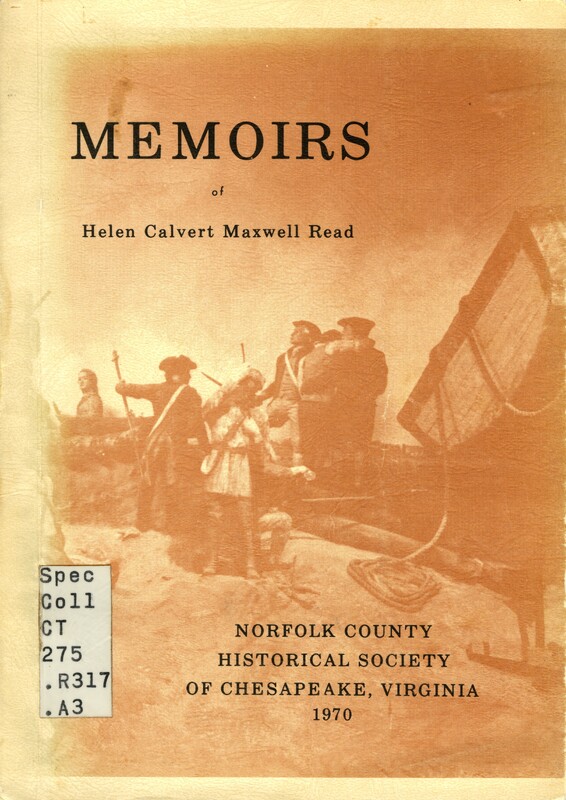
Memoirs of Helen Calvert Maxwell Read
Sources & More Information
- Memoirs of Helen Calvert Maxwell Read Call Number: Spec Coll CT 275 .R317 .A3