Bertha Fanning Taylor (1883-1980)
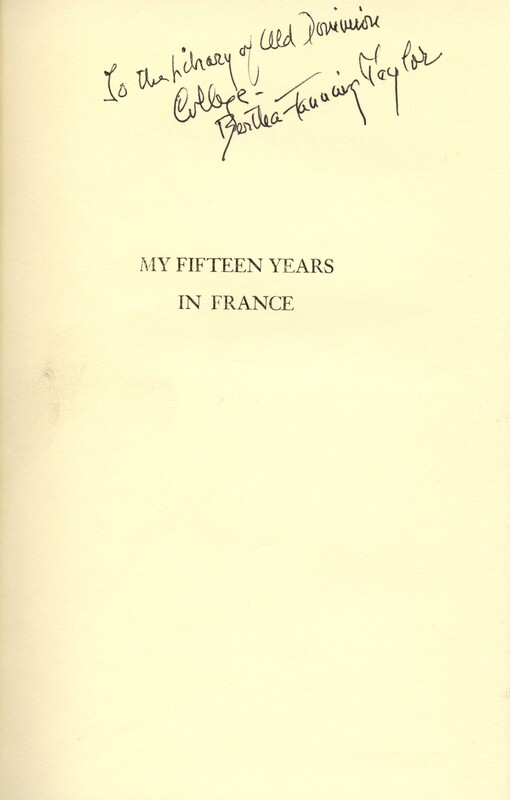
"My 15 Years in France" was published in 1968 by Bertha herself. There is a handwritten dedication in the beginning of the book signed by Bertha that says, “To the Library of Old Dominion College.”
Early Life
Bertha Fanning Taylor was born on July 30, 1883, in New York City. The first sentence in her book is, “I grew up as a young girl who felt she was singled out for misfortune.” Typically, when a memoir starts out like that, the story does not end well for the author. Bertha’s story is an exception.
Bertha’s mother died when she was six, and her father passed away shortly after, both of tuberculosis. She moved to Spotswood, New Jersey to live with her aunt and grandmother. Bertha recalls this tragedy by saying, “I can remember a sense of upheaval and impending change, with furniture packed for a move, and my mother very ill– and then being gently told that I would never see her again.”
Growing up with this grief was not easy for Bertha. She wrote, “I must, however, have missed my mother, and felt the grief of my guardians, and they gave me an inborn sense of unfortunate destiny for they wished to keep alive in me the memory of my mother, and thus made me realize that my fate was different from that of other children who had their parents and their own homes.”
Bertha recalled charming memories from this time in New Jersey. She only went to the village school for one year at nine years old, but her aunt taught her reading, math, philosophy, and even some French. Her grandmother taught her sewing, as well.
One of the moments I found most endearing about Bertha’s childhood was that she and her brother, who was two years younger than her, would often play games together that Bertha made up herself. She said she had an active imagination and created wild, detailed worlds inside her head. I imagine she did what every older sister does and made her little brother go along with everything she said. I say that because I did the exact same thing.
When she was ten years old, Bertha was told she had to go live with her other aunt in New York and go to school there. She started going by her middle name, Louise, and she also made up her mind to become an artist. She was very homesick, however; she mentioned that her cousins she was living with were not her age, and the city life was not built for the outdoor imagination games she once played. Her school was very strict, as well, and she said, “I quickly felt injured by any unjust criticism, and indulged in many periods of secret tears.”
To pass the time, Bertha took up reading. The family she was living with was Baptist, and she attended Baptist Sunday School for a while, before identifying as Episcopalian like her family in New Jersey. She started going to a Lutheran Church after that.
Bertha moved around New York for a while, living with different family members and continuing to foster her love for art. She took music lessons, visited the Metropolitan Museum of Art, and spent five years in college after graduating from high school. She claimed to be a commuter student, which she said she liked. How, I have no idea.
Unfortunately, upon moving in with one of her (many) aunts, Bertha learned that her brother, who had been taken in by the family, had sadly passed away. She moved away from New York for a bit when her health declined slightly, making her unable to eat. After spending a few months away from the city in her childhood home in Spotswood, NJ, the problem resolved itself; she also spent her summers there, painting the beautiful scenery. She even started a kindergarten in Spotswood to get some money for the art school she wanted to go to, which her uncle helped her get a spot in.
Building a Family
Bertha attended school for a while but decided she would rather focus on settling down and getting married to a man she desired, so she stopped going. She took up a job as a “helper,” she called it, which was similar to being an Au Pair. After two years, she and her husband Norman Taylor, who she dubbed “N.T.” in her book, got married. Bertha gave birth to a son, Norman Junior, and two daughters, Marian and Alice. When their kids were growing up, Bertha and Norman decided to move to a large house on Long Island. Bertha got into art again and was chairman of the Art Committee in a nearby town.
A few years into life in Long Island, Bertha found out her husband was romantically involved with someone else, and she took matters into her own hands. She said, “With the absence of mental peace in the household, I had decided that perhaps the best move was to go to France, and let the disruption of all my plans give place to new plans which could perhaps provide better educational advantages than could otherwise be provided should the break in the family really come about and our income, small as it was, be still further reduced.”
Life in France
So, Bertha and her two daughters moved to France in 1924, and the exchange rate for the American dollar was really good. Her son remained in the United States to attend school in New Jersey. Bertha had heard about a place for herself and her daughters from one of her friends, and since she was already well-versed in French, she got along well with the family who was accommodating them. Also in the house were two girls close in age with Bertha’s daughters. They were living in Montpellier, which was suburban, as opposed to the city life she had raised her kids in so far. She mentioned they were homesick at first. The house they stayed at was one with a matriarchy, and Bertha said she liked that a lot about France: women were much more respected and treated well.
Bertha’s daughters were enrolled in a Lycée, which was a type of secondary school funded by the government. Children were expected to learn strict discipline from a young age. Bertha enrolled at a university, studying French and Art. It seemed, however, that she could not imagine a woman being feminine and scholarly at the same time. She said, “If I should become accustomed to living without my husband, would I ever want to risk a return? Would I not develop that other side, the more intellectual me, so that I could no longer be content with the role of the mythical feminine?”
Ultimately, Bertha ended up proving herself correct. She never mentioned remarrying, and the idea only came up a few times. She grew to understand this part of herself, and said, “Here in France my moments of sadness over the loss of a dear comrade, over my disrupted ideals, uprooted affections for the familiar objects of daily life, were rapidly giving place to the joy of mental growth and to a suspicion that the atmosphere in which I had been living had not been conducive to my real growth, mentally or spiritually, dearly as it had held my affections!”
Life was getting better for Bertha. She decided to move to Paris, and her son joined the rest of the family in France, too. Bertha got a job at the École des Beaux-Arts, then at the Grande Chaumière, which was a sort of laid-back art school. She also worked as a translator of French for museum tours at the Louvre and even gave a few talks in some galleries. Later, she wrote for an American newspaper with a weekly column on art exhibitions in Paris. She continued to take art classes at several different places, and even got access to studio spaces, and said, “I am perhaps a born teacher and student. The constant need for further study, the effort to condense one’s knowledge and ideas, the ability to speak without notes–all of this I found extremely interesting, even though the small sum gained made it necessary to have an income or do other jobs.”
Occasionally, Bertha offered some philosophical thoughts on her time in France, such as, “How true is it that education and experience are the only real possessions this life can net us! What we have seen and done and sensed, either in imagination, or in action revived in imagination, that is, after all, the most real possession we have.” She also wrote:
“In fact, as I continued to live in France, I was constantly impressed with this sense of the Nation which seemed to dwell within the individuals, no matter what their station in life; it was this that made for such dignity in the celebration of public functions, parades, state funerals, the official opening of exhibitions–the feeling that ceremony was the tangible expression of a sentiment, and that the sentiment throned above any pride in the purely mechanical organization and expressed itself through it. We have allowed our democracy to almost kill that innate artistic sense in the human animal that sentiment must find expression in ceremony where it concerns multiple expression, and that ceremony arises from the need for a common expression of sentiment.”
Bertha also took a love to Italy. She travelled to Florence once, and then one of her daughters married an Italian man and moved to Italy, so she visited more often. She also fell in love with Rome, and wrote, “Thus I began to feel that I had gotten to that state in my knowledge of the city that I felt at home there, and continually aware of the great epochs of its history.”
As for her family, Bertha’s children also thrived in France. Bertha said she valued the French education system much more than the American one. Bertha became a grandmother after one of her daughters had a baby. She also kept up with Norman’s family, who lived in England, and mentioned visiting them several times.
Bertha went to the World’s Fair of 1937 in France, and wrote in her journal, “I am thoroughly enjoying the Exhibition for its many fascinating shapes, its revelation of the unkillable vitality of this old Europe. There is something very beautiful and almost pathetic in the crowds of people here each day with fine music in the air–a very excellent choice–with the flavor of holiday-making, of joy in a sad and hard-worked world.”
Artwork by Bertha
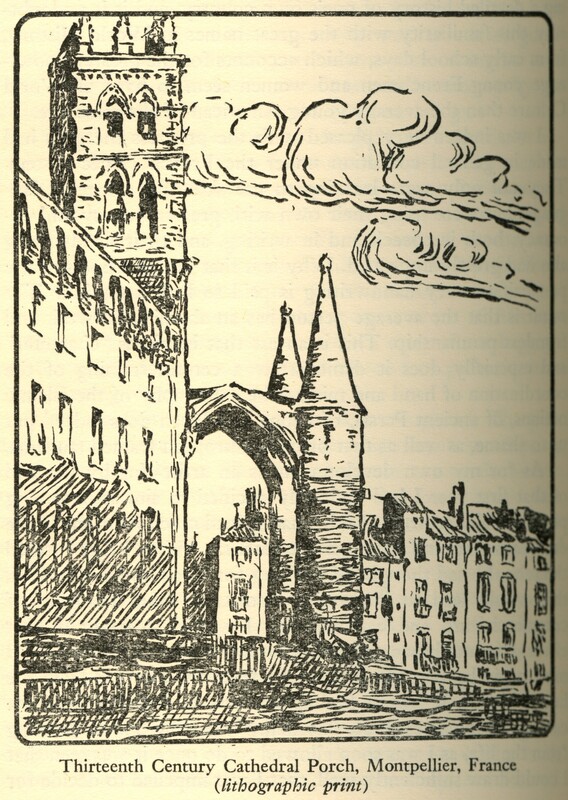
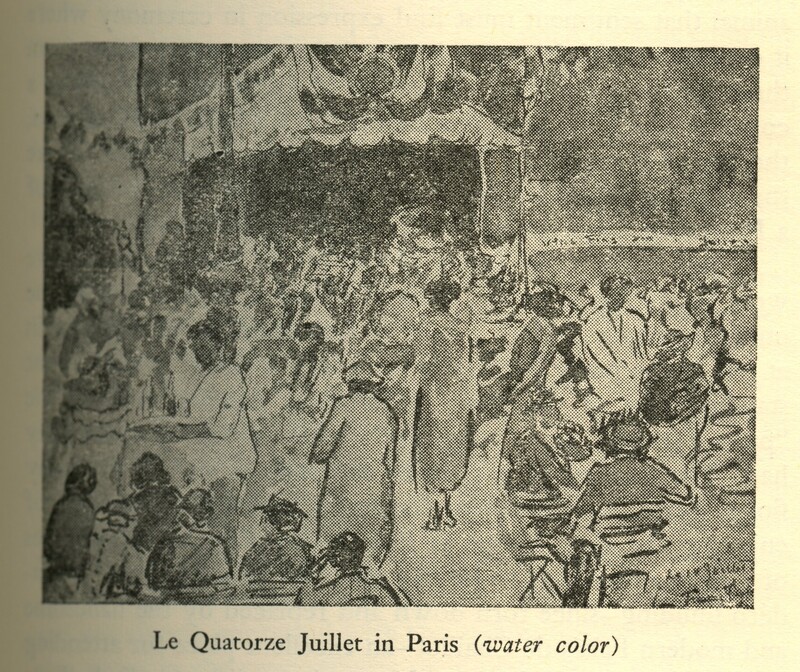
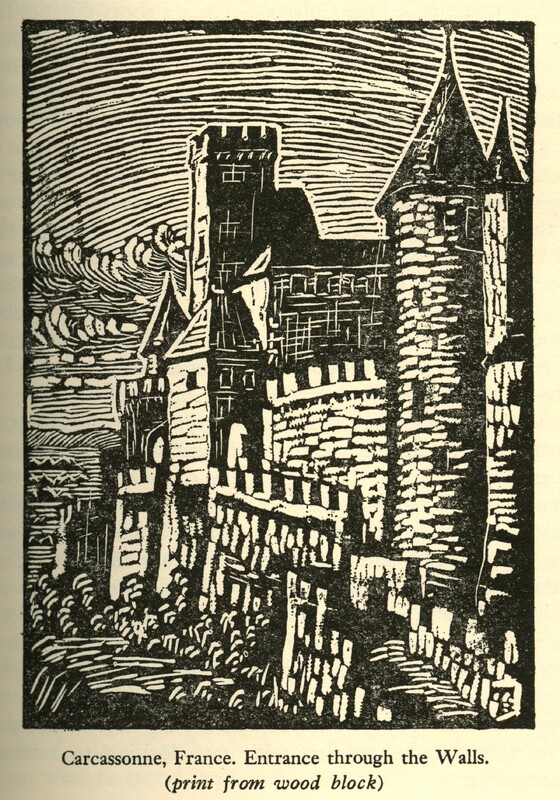
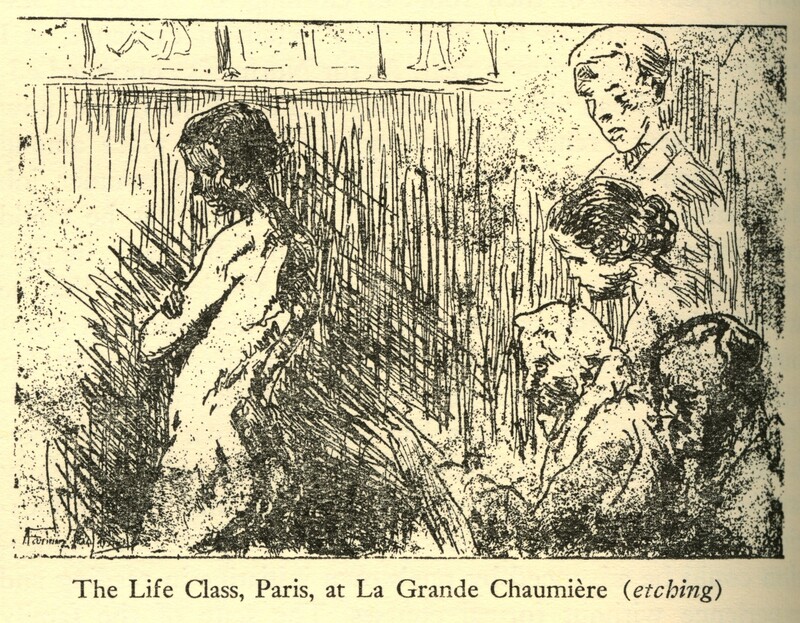
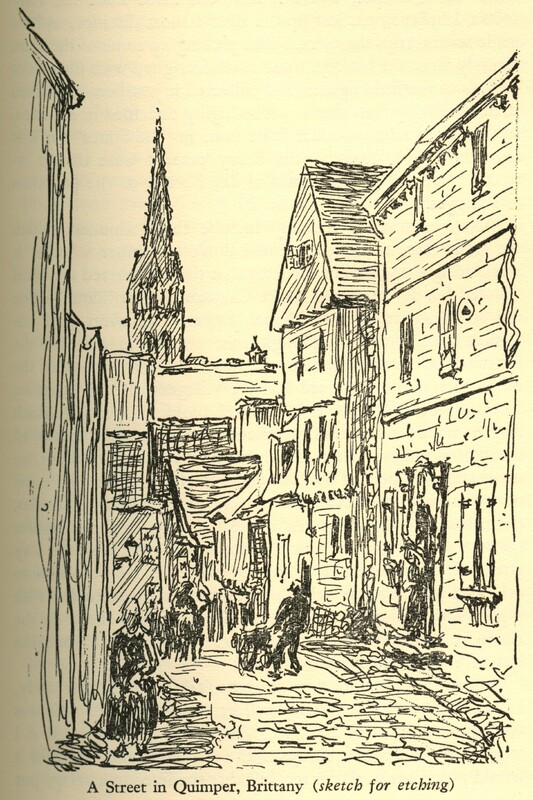
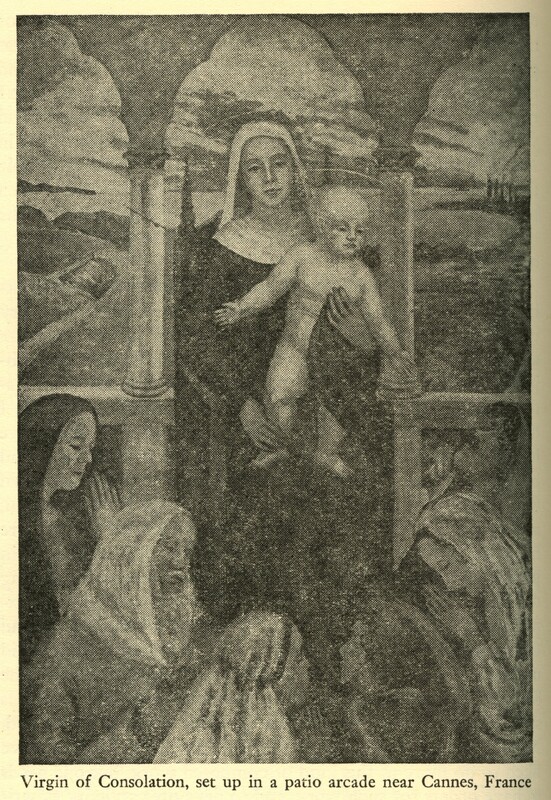
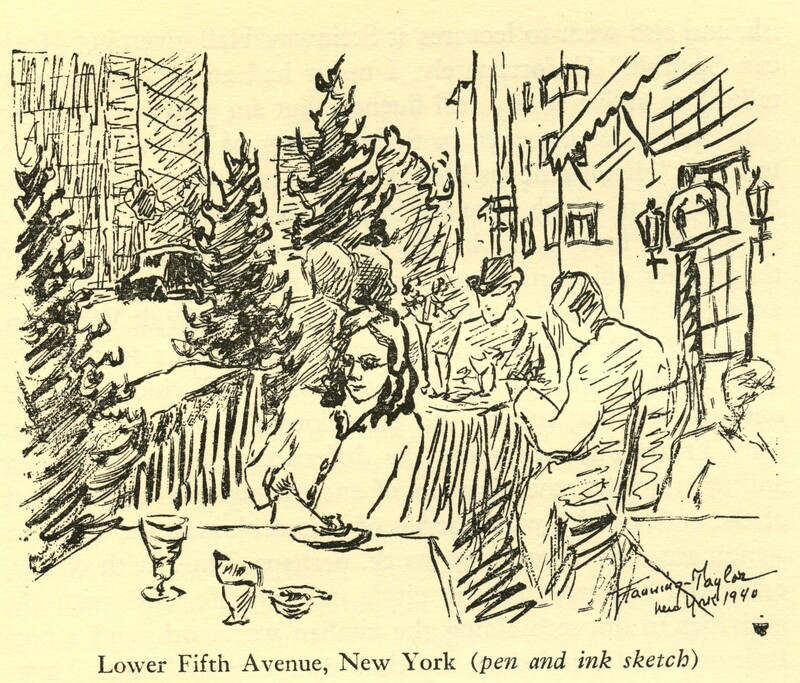
A New Life in Norfolk
At the start of World War II in Paris, Bertha described feeling incredibly anxious. She mentioned a bomb scare, with sirens blaring in the street; she went to her neighbor’s house and sat in their basement until there were assurances that there would be no bombing.
“We fully expected Paris to be bombed at any moment. One who has not lived through that tenseness of expecting one’s very life to be blown to pieces at any moment, can scarcely realize how it affects one. The actual fear one surmounts–as of course soldiers must–and it is as nothing compared to dismay at not being able to plan one’s activities with any assurance. All seems futile, and what, indeed should one occupy oneself with? One gets used to anticipating the worst and preparing reasonably for it…my usual life was, of course, completely finished…Nothing is more useless in wartime than a lot of paintings and yet, to me, they were valuable and represented my past life.”
Bertha had to leave Paris due to World War II. She could only take one or two of her art pieces with her, and one of them is in the Chrysler Museum of Art’s permanent collection. She contemplated going to live with her daughter in Italy, but she learned it was safest to return to America, and Bertha was devastated. She moved back to New York and wanted to work at the Metropolitan Museum, but she was too close to retirement and had an unfinished degree. For four years, she remained in New York City.
In 1944, Bertha took a job in Norfolk as Curator for the Hermitage Foundation Museum, and she gave a few art lessons here and there throughout Norfolk. She became the Director at the Norfolk Museum, and joined a club called “Salon Français” for French speakers in the city. She also taught adult painting classes. She continued to live in Norfolk until she passed away in 1980.
Sources & More Information

My 15 Years in France by Bertha Fanning Taylor
Works Cited
- My 15 Years in France Call Number: Spec Coll ND 237 .T39 A3 1968
- Wikipedia Contributors. “Bertha Fanning Taylor.” Wikipedia, Wikimedia Foundation, 25 Sept. 2025, en.wikipedia.org/wiki/Bertha_Fanning_Taylor. Accessed 2 Mar. 2026.
Additional Resources
- There are more materials about Bertha Fanning Taylor in the ODU Special Collections and University Archives! Check them out here: Bertha Fanning Taylor Papers | Special Collections and University Archives Collection Guides